Is Monero traceable? What the chain hides, and what still gives you away
Cette publication n’est pas encore traduite ; l’original anglais est affiché.
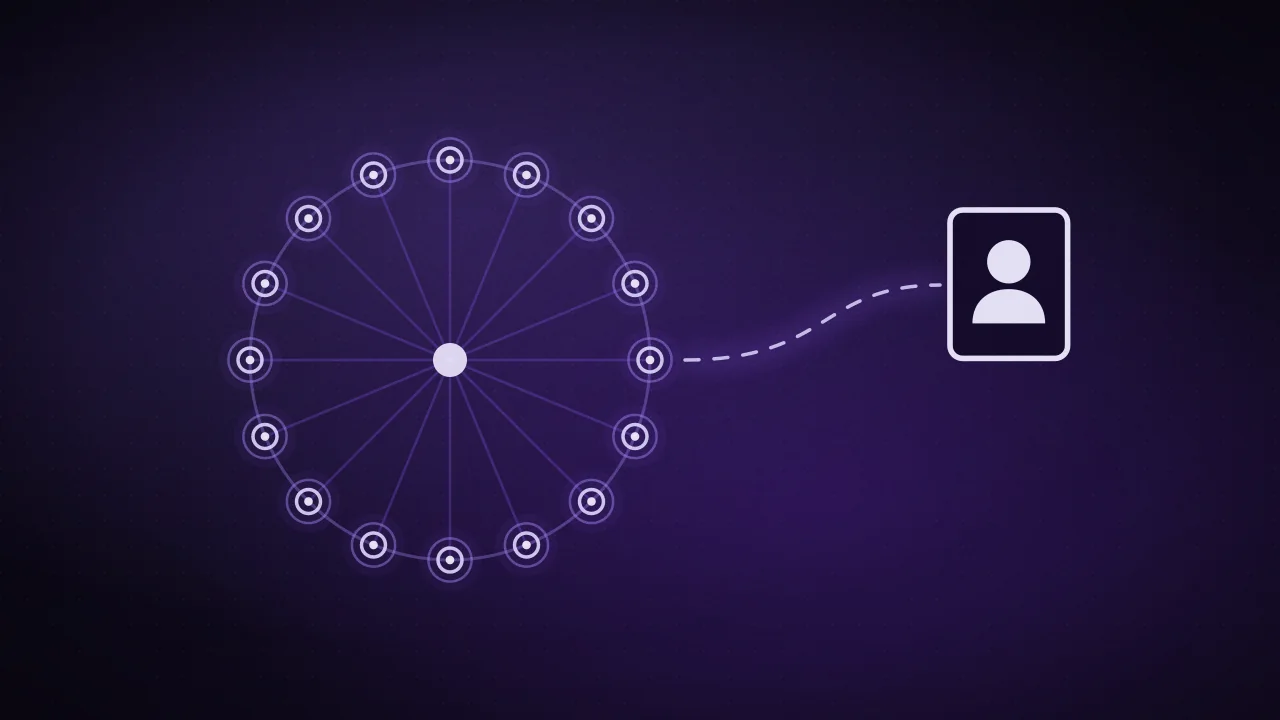
The short answer: on the blockchain, not the way Bitcoin is traceable. Every Monero payment hides the sender among sixteen possible ones, sends the coins to a one-time address and hides the amount. But the chain is only one of three places a payment leaves a trace. The other two, the network and the edges, are where Monero users actually get identified.
What makes Monero untraceable?
Three techniques, each covering one part of a payment.
- Ring signatures hide the sender. Every spend is signed together with fifteen other outputs taken from the chain, so an observer sees sixteen possible sources and cannot tell which one is real. The ring has had sixteen members since the network upgrade of 13 August 2022; before that it had eleven. Monero's own documentation says: "There is no way an outside observer can tell which of the possible signers in a signature group belongs to your account."
- Stealth addresses hide the receiver. The sender creates a new one-time address for every payment, so the address the recipient published never appears on the chain.
- RingCT hides the amount. Amounts have been hidden since January 2017, and in every transaction since September 2017.
Is Monero 100% anonymous?
No, and the difference matters. A ring of sixteen is plausible deniability, not invisibility: the real input is one of sixteen, and anything else an observer knows about you can narrow the choice. Monero also lets you open your wallet on purpose. A view key lets whoever holds it see your incoming payments: an accountant, an auditor, a court. In the project's words, "you can decide who can see your Monero balance by sharing your view key."
Can Chainalysis or the IRS trace Monero?
- The IRS paid to try. In 2020 it awarded contracts to two firms, Chainalysis and Integra FEC, to build tools for tracing Monero, worth up to $625,000 each, as Decrypt reported at the time. We have found no public result of that work.
- Chainalysis showed how it works. In September 2024 a Chainalysis training video leaked. According to Cointelegraph and Decrypt, it described the firm running its own Monero nodes from many locations and internet providers to record the IP addresses and timestamps of transactions sent through them. In the same video the presenter described Monero as unlinkable and untraceable on the chain. The method targets the network, not the cryptography.
Where Monero users actually get identified
- The node your wallet talks to. A wallet has to send its transaction through a node. A remote node you do not run sees your IP address and the moment you broadcast, which is exactly the data the leaked video was about. Your own node, or a connection over Tor, takes that away. Which wallets let you choose is in our note on anonymous wallets.
- The exchange at either end. If you bought Monero on an exchange that holds your passport, it knows the amount, the time and the address it paid out to. The chain hides what happens next; it cannot erase what the exchange recorded. The KYC level on a catalogue page answers that question for each service, with evidence.
- Amounts and timing. Sell 3.27 XMR an hour after receiving 3.27 XMR, and the coincidence says what the ring does not.
Is Monero still untraceable in 2026? What FCMP++ changes
- Today. The network runs version 0.18.5.4, released on 16 October 2026. The ring still has sixteen members.
- The next upgrade. FCMP++ replaces rings with a proof that spans the whole chain. Its developers explain: "instead of making a ring signature proving you own 1 of 16 Monero outputs, you make a proof that you own 1 of the 150 million+ Monero outputs from across the entire Monero blockchain."
- When. It is being tested on a separate stress network, which forked on 5 October 2026. The release of 26 October closed a "detectable inflation vulnerability" that had been open on that test network for the first 24 hours; the main network does not run the new code and was not affected. No date for the main network has been announced, and Monero's roadmap lists the upgrade as "Coming Soon". Dates quoted in the press do not come from the developers.
Monero vs Bitcoin privacy
- Bitcoin. Sender, receiver and amount are public. Privacy comes from tools added on top: fresh addresses, CoinJoin, mixers, each with its own weak points (our note on mixers).
- Monero. All three are hidden by default, in every transaction. The weak points are the network and the edges, not the chain.
What to check before you trust the edges
- Who runs your node. Your own, or one you reach over Tor. Monero wallets in the catalogue are in the wallets category: Feather, Monerujo, Cake Wallet, Stack Wallet.
- Where your Monero comes from and where it goes. Of the 21 exchanges and DEXs in this catalogue that trade Monero, seven are at KYC level 0 and four at level 3, where documents can be demanded with your funds already deposited. Every route is compared in our note on buying Monero without KYC.
- Whether your amounts and timing repeat. No protocol protects a pattern you create yourself.
Sources: Monero — network upgrade of August 2022 · Moneropedia — ring signatures, stealth addresses, RingCT · Monero 0.18.5.4, 16 October 2026 · Monero roadmap · FCMP++ stressnet v3.1, 26 October 2026 · Decrypt — IRS contracts, 30 September 2020 · Cointelegraph — leaked Chainalysis video, 9 September 2024 · Decrypt — fact-check of the video